Funded master's degree - UVic
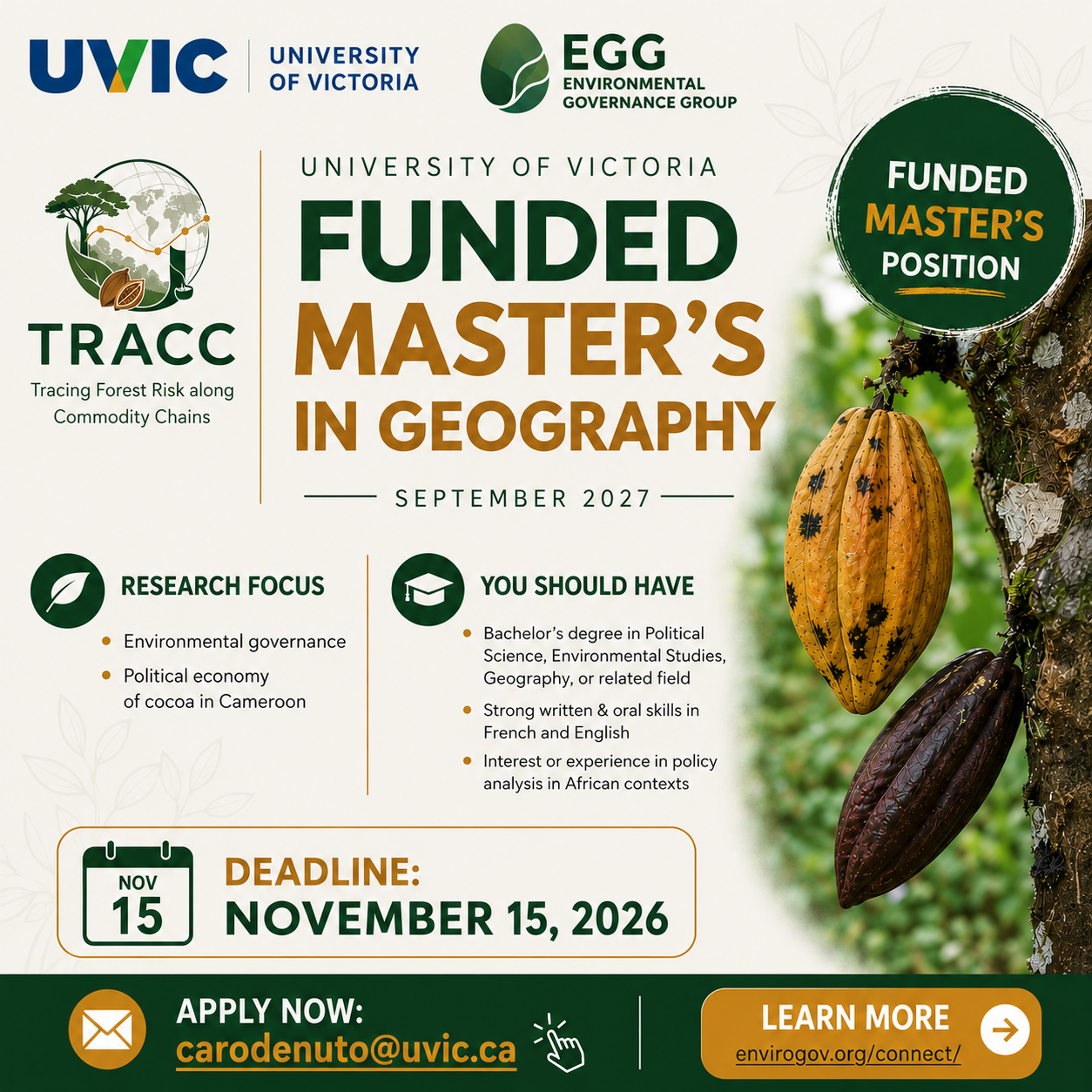
UVic’s Environmental Governance Group (envirogov.org) at the University of Victoria (UVic) in British Columbia, Canada is seeking applications for a Master’s student to conduct research on environmental governance and political economy of cocoa in Cameroon. The position will begin in September 2027.
Read the complete job description here.
Research Focus
The Master's research project will examine how sustainability initiatives, traceability requirements, and emerging deforestation regulations are reshaping the cocoa sector in Cameroon. The student will conduct fieldwork in Cameroon, working with stakeholders across the cocoa sector to understand how different actors perceive and respond to evolving sustainability requirements. Field research will include semi-structured interviews, participant observation, and policy analysis, with opportunities to engage directly with farming communities, cocoa traders, exporters, government agencies,
and civil society organizations.
The position includes one year of graduate coursework in theory and research methods, followed by the design and implementation of an independent research project. The successful applicant will gain training and experience in qualitative research methods, political economy, environmental governance, and global commodity chain analysis while contributing to an internationally collaborative research initiative.
Where is the position based?
The successful applicant will be based at the UVic’s Department of Geography, but work with a larger interdisciplinary team of researchers, including Dr. Lu’s team based at the University of British Columbia.
The position is part of our Tracing Forest Risk along Commodity Chains (TRACC) project, funded by the Social Sciences and Humanities Research Council of Canada (SSHRC).
Qualifications
In order to apply, applicants must have:
- Obtained a Bachelor’s degree in Political Science, Environmental Studies, Geography, or related field.
- Strong written and oral skills in French and English.
- Excellent communication, writing, and organizational skills.
- Those with work experience will be preferred, with particular preference for those with policy analysis in the African context.
The ideal candidate will have a strong interest in, and potentially work experience in agrifood commodity or supply chain sustainability policy. The ideal candidate should also be highly motivated to work independently.
How to apply?
As soon as possible, interested applicants should send to Dr. Sophia Carodenuto (carodenuto@uvic.ca subject line “2027 TRACC Master’s position”):
- A cover letter detailing how they meet the above listed qualifications for this master’s position. Cover letters should explicitly identify how previous academic and/or work experience are related to the skills required for the advertised position.
- A CV detailing academic achievements, conferences and publications (including links where possible)
- Unofficial transcripts
Only those candidates of interest will be contacted for an interview, so we ask that you do not send follow-up emails regarding the status of your application. We will review applications until the position is filled.
Deadline is December 31, 2026 but early applications are highly encouraged.
Equity, Diversity, and Inclusion
The University of Victoria is committed to upholding the values of equity, diversity, inclusion, and human rights in our living, learning, and work environments. In pursuit of these values, we seek students who are eager to actively participate in creating a respectful, collaborative, and inclusive research community.
We welcome applications from individuals of all backgrounds and actively encourage applications from members of historically and systemically marginalized groups, including Indigenous Peoples, Black and racialized persons, persons with disabilities, women, and members of 2SLGBTQIA+ communities.
We recognize that excellence can be demonstrated through diverse experiences, perspectives, and career pathways. The Environmental Governance Group is committed to fostering an inclusive research environment that values diverse forms of knowledge and promotes respectful engagement with research participants,
communities, and partners in Canada and internationally.
You should also read:
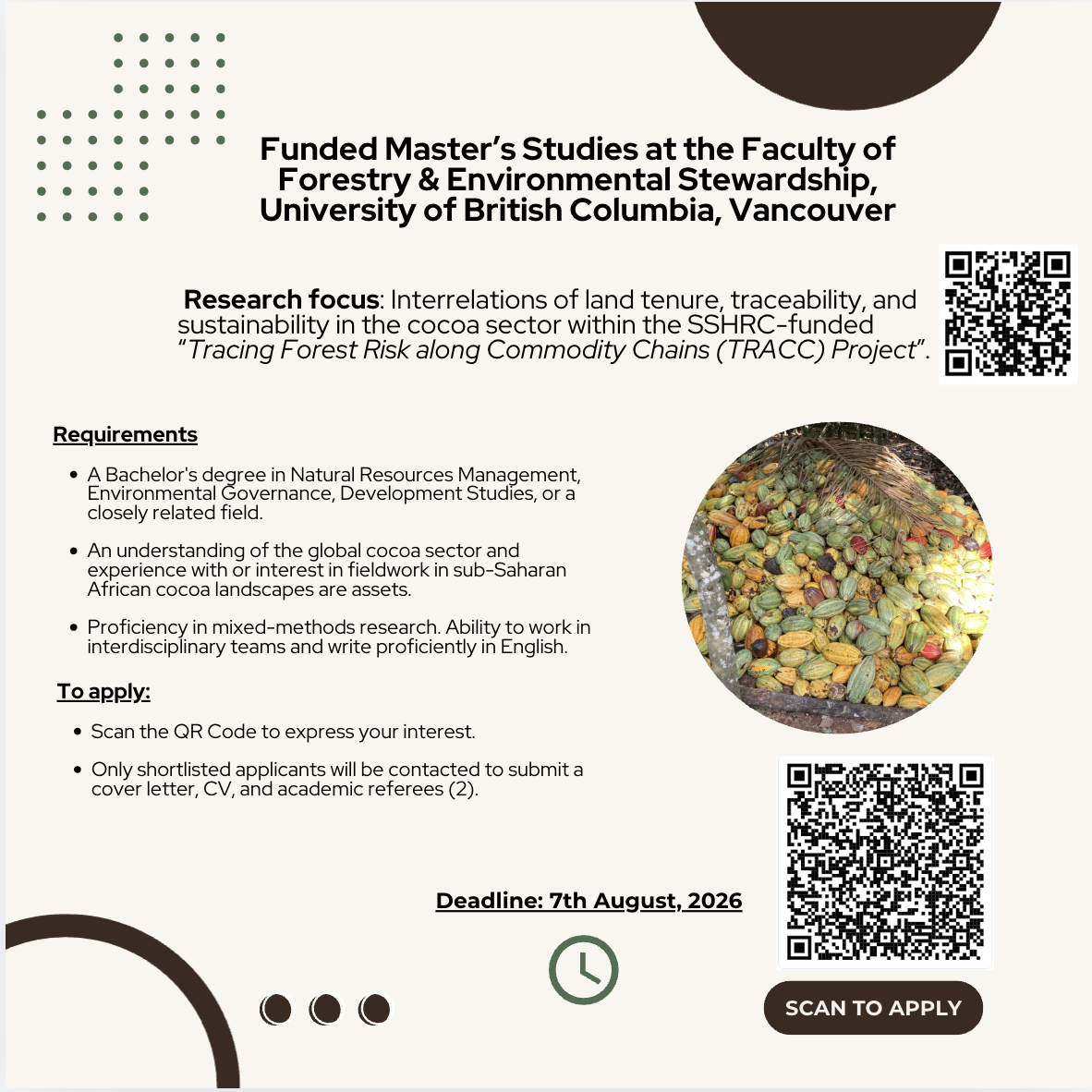
Funded master’s degree - UBC
We are inviting applications for a funded Master's position at the Faculty of Forestry & Environmental Stewardship, University of British Columbia (Vancouver), starting in September 2027. Explore the interrelations of land tenure, traceability, and sustainability in the cocoa sector in Ghana. The position is part…
Continue reading...